2 Hours, Online
Consider the various sources of finance available to entrepreneurs: Beyond basic bootstrapping, there are corporate ventures, angel investors, crowdfunding platforms, accelerators, VCs, banks, public grants, co-investment funds, business plan competitions, technology transfer offices, family offices, private equity investors and stock exchanges. With the notable exception of angel investors, all these sources provide only money, nothing more.
The only true sources of smart finance are angel investors, who are able to influence a country’s economic development by providing more than just money to entrepreneurs and SMEs. They with Angel investors contribute their own know-how, provide mentorship, and share their own networks in contributing to the businesses they invest in. They are thus the main drivers of innovation and the natural leaders of the world’s early-stage investment markets.
The objective of these short courses is to introduce important parts of angel investment system to those considering investing in startups, SMEs and high-growth companies by using their own money and own know-how. The courses aims to give the basic principles of angel investment and to-dos and not-to-dos while investing as a qualified angel investor.
Wishing you a great success!
WBAF Business School - World Business Angels Investment Forum
An affiliated partner of the G20 Global Partnership for Financial Inclusion (GPFI)
By the end of this programme, you will be able to create, design, and accelerate women entrepreneurship and business development across geographies & functions, enabling you to be a key contributor to any company’s, institution or organization purpose, and above all a differentiator in the decision making tables.
The program is constituted by case studies, readings, presentations, infographics, small video capsules, and practical cases; with the most recent entrepreneurship research, always taking in consideration female perspective which is emphasized on 2030 Agenda.
If you are a woman that is looking for new perspectives and approaches; this course is ideal for you.
The WBAF Business School provides a hybrid learning experience in a multilingual and multi-cultural environment offering (a) online education (b) support from an individualized strategic advisory board, (c) stock exchange meetups and inter-continental study trips, (d) support from a corporate governance and SME support center and (e) proficiency-based qualification and certification.
In this module you will learn how to develop your personal leadership style and strengthen your influence and impact within your organization. You will obtain essential skills you need — to enhance your power, navigate the workplace, and take the lead.
Presentation by the lecturer: 50 min
Q&A: 10 min
This module is a unique opportunity for all participants to know how to do business globally while obtaining further develop cross-cultural competences. We will study how to do business by region, do’s and don’ts, and efficient practices to close international businesses.This module is a unique opportunity for all participants to know how to do business globally while obtaining further develop cross-cultural competences. We will study how to do business by region, do’s and don’ts, and efficient practices to close international businesses.
Presentation by the lecturer: 50 min
Q&A: 10 min
In 2015, the UN General Assembly unanimously adopted the 2030 Agenda for Sustainable Development (the 2030 Agenda). The 2030 Agenda established 17 Sustainable Development Goals (SDGs) to achieve transformative change with respect to people, the planet, prosperity, peace and partnership. The 2030 Agenda states that: “Private business activity, investment and innovation are major drivers of productivity, inclusive economic growth and job creation” for that reason on this module participants will learn how to apply those on their businesses.
The Women’s Empowerment Principles (WEPs) are a set of Principles offering guidance to business on how to promote gender equality and women’s empowerment in the workplace, marketplace, and community. Established by UN Global Compact and UN Women, the WEPs are informed by international labour and human rights standards and grounded in the recognition that businesses have a stake in, and a responsibility for, gender equality and women’s empowerment.
Presentation by the lecturer: 50 min
Q&A: 10 min
In this module students will gain an overview on different types, stages and common tactics in negotiation. But also will apply the gender perspectives in negotiations, combined with burgeoning research on positivity and mindfulness, we will offer strategies that can help women both choose to engage and perform more effectively in negotiations.
Presentation by the lecturer: 50 min
Q&A: 10 min
In an increasingly uncertain business world , digital knowledge and skills are now just as important as traditional production and trade knowledge. Digital literacy is about using technology to find, use and share information. It is about securing raw materials. It is about maintaining communications with current customers, and finding new ones. It is also about understanding the importance of privacy, security and assessing the credibility of information. This module aims to help women owned businesses (WOBs) gain the digital skills necessary to engage in a digital economy and improve livelihoods.
Presentation by the lecturer: 50 min
Q&A: 10 min
Strengthen access to finance and investment readiness of women-owned and women benefitting companies or ventures in target countries and across multiple sectors is a priority nowadays. The main barrier to increasing the participation of women in business remains access to finance.
Research indicates that women tend to be loyal customers and cautious investors, in addition to having better loan-payback rates. Serving this market has a positive impact on society as a whole by expanding economic growth and job creation.
Presentation by the lecturer: 50 min
Q&A: 10 min
A business network of contacts is both a route to market, and a marketing method. Business networking offers a way to reach decision-makers which might otherwise be difficult to engage with using conventional advertising methods.
The network success hypothesis assumes a positive relation between the networking activities of founders and their ventures´ success. The rationale behind this hypothesis is the theory of socially embedded ties that allow entrepreneurs to get resources cheaper than they could be obtained on markets and to secure resources that would not be available on markets at all, e.g. reputation, customer contacts, etc.
In this module participants will learn how build successful business relationships to scale up and grow their businesses.
Presentation by the lecturer p: 50 min
The participants will be evaluated with a practical case developed in teams, also with a test.
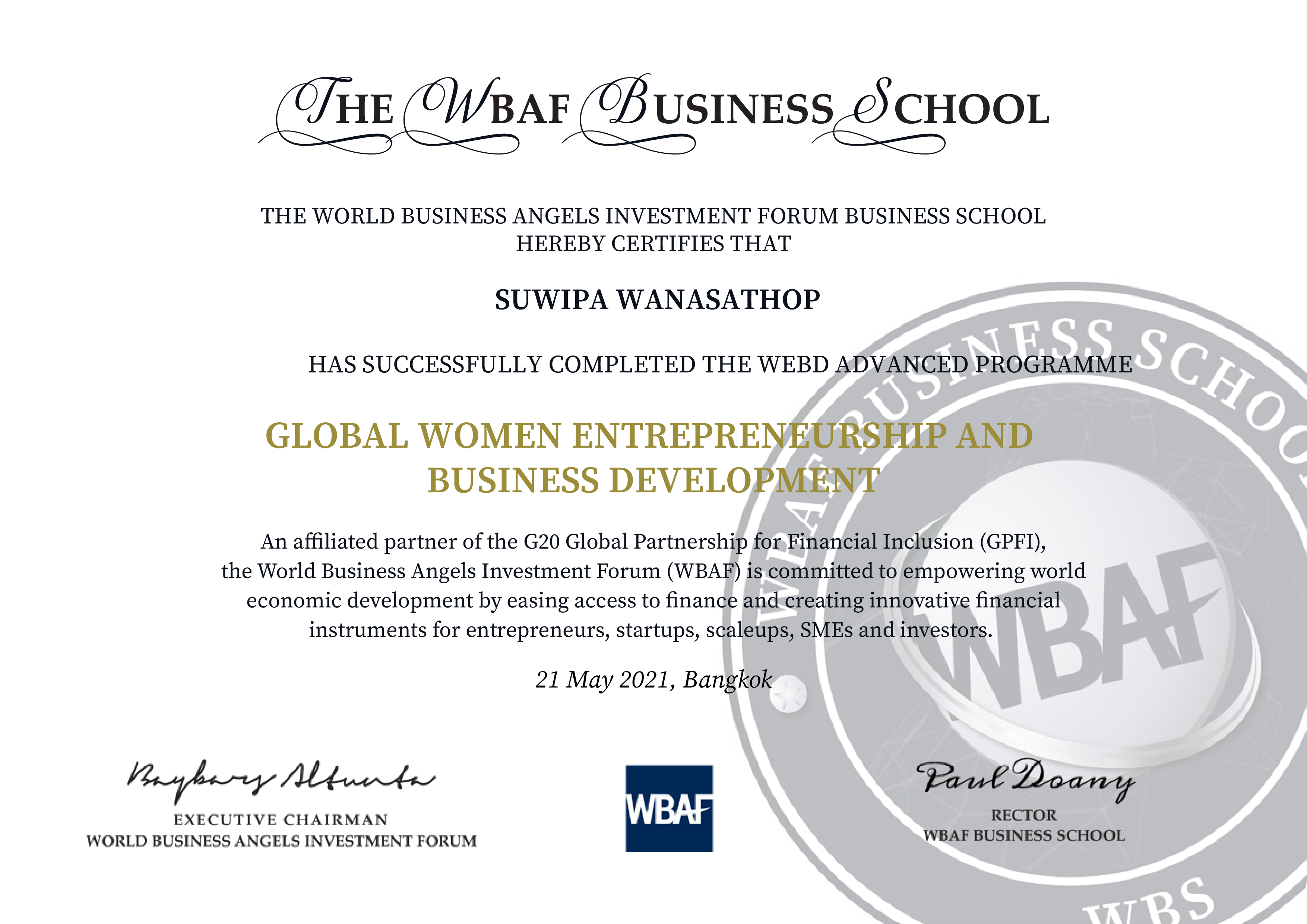
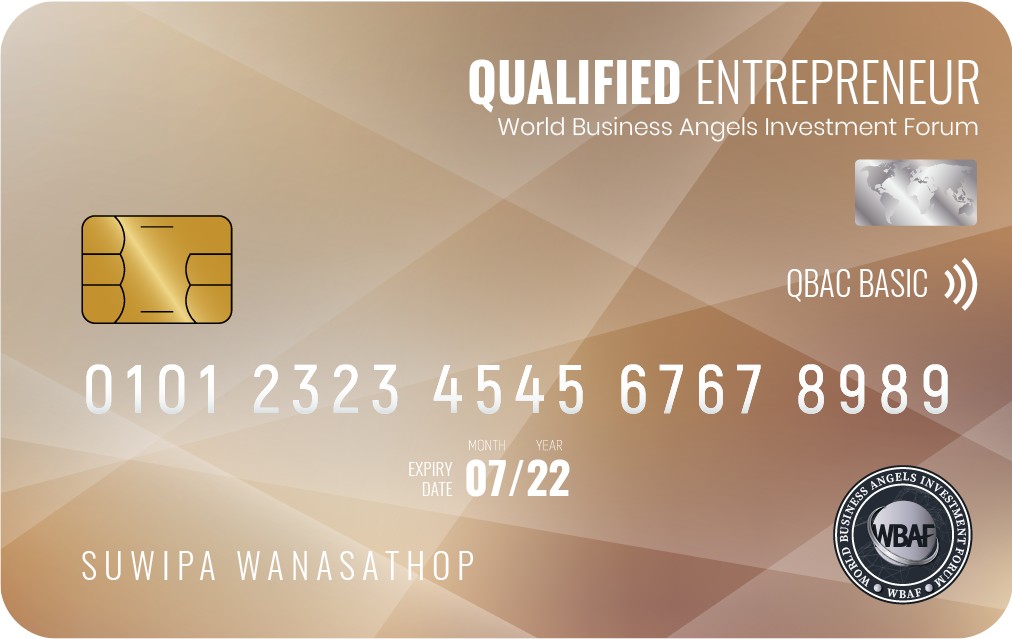
The programme concludes with a proficiency test and participants are awarded a professional certificate featuring your proficiency level and a personal WBAF Identity Card. The WBAF Business School awards two kinds of certificates: (a) a professional certificate is issued for successful completion of a programme that concludes with a proficiency test, and (b) a certificate of completion is issued for a course without a proficiency test.